Physical Address
304 North Cardinal St.
Dorchester Center, MA 02124
Physical Address
304 North Cardinal St.
Dorchester Center, MA 02124


Surantana TewariThat and the Asian seasonal thief, Tokyo
 BBC
BBCLast year, more than 18,000 people living with Demyia left their homes and traveled around Japan. Almost 500 of them were later found dead.
Police said such cases have doubled since 2012.
Older people aged 65 and over now make up nearly 30% of Japan’s population – the second-highest proportion in the world after Monaco, according to the World Bank.
This criss is further driven by the shrinking labor force and the strict limits on foreign workers who are in care.
The Japanese government has identified the transition as one of the most urgent policy challenges, with the Government’s estimate that the tyne’s will reach 14 skilluns filled by 2025.
In its latest strategy, the government has signaled a stronger perivot to technology to relieve pressure.
Across the country, people are adopting GPS-based systems to track people who travel.
Some areas offer wearable GPS tags that can alert authorities at a moment’s notice of a designated area.
In some cities, shopkeepers receive real-time notifications – a kind of community safety net that can find missing people within hours.
Another technology aims to detect early induction.
Aigit Afitsu uses Ai to analyze gestures and Return Patterns, picking up early signs – Shuffling when walking, slowing down or producing routines.
“Early diagnosis of diseases that are seasonal,” said Hidenori Fujara, a spokesman for Fujits. “If doctors can use the data to capture the handling, they can prevent and early onset and help people stay active for a long time.”
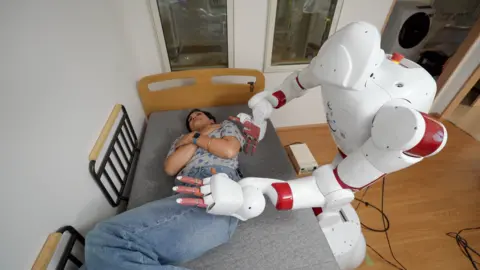
Meanwhile, Research in Sagara Universfikasi is developing with robots, for human robots are designed to be “musagka” trainers.
It can help people who put on socks, eggs gear and shiny. Scientists in Aysia hope that in the future, Airec, will change the trés and prevent beds in patients.
Similar robots have been used in home care to play music to residents or guide them in simple stretching exercises.
It also monitors patients at night – placed under the mattress to monitor sleep and condition – and cuts back to humans who do it.
Although robots are surprisingly developed for the future, the professor’s assistant to Myies Miyéma said the level of priority and recognition will be carried out in the last five years.
“It requires fabric and institutional understanding – how to adjust for each person and situation,” he said.
Emotional support is also part of the innovation drive.
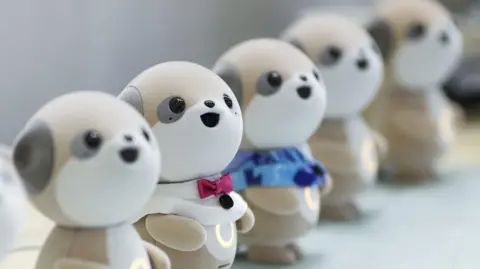
Poketomo, a 12cm tall robot, can be carried in a bag or can fit in a pocket. It reminds the user of you partially, tells how to prepare in real time for the weather outside and offers its own advice, which the advisor helps.
“We swear on social problems … and use new technologies to help those problems,” Miho Kno, Mensa development from Séas told the BBC.
While devices and Robots offer new ways to help, the human connection remains idle.
“Robots must deplots, not replacements, human beings,” MR Niyde, The scientist Israfina says. “While they may take on some tasks, their main role is to help work with patients.”
In the restinautan wrong order in Sengampa, Tokyo, intended by Akiko Kanna, lazy to be served to be served from trimming.
Inspired by her father’s experience with the situation, MS Kanna wants a place to keep her emotions and feel good.
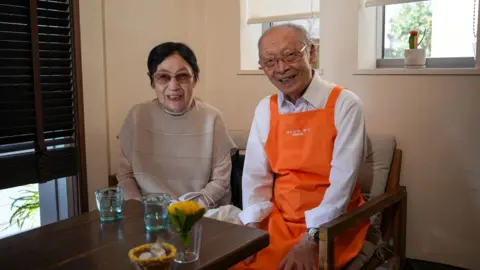
Toshio Morita, one of the cafe’s servers, uses flowers to remember which table ordered what.
Despite his cognitive decline, Mr Morita likes to interact. For his wife, the Café provides respite and helps keep him reformed.
Kanna’s illustrates why social interventions and community support remain important. Technology can give the device and the relative, but the meaning is spread and the human connection is what is true and the menu of people who live and admire.
“Honestly? I want a little pocket money. I like to meet all kinds of people,” Mr. Morita said. “Everyone is different – that’s what makes it fun.”
 Getty Images